


Walk into any skincare conversation in 2026 and you will hear three words over and over: PDRN, glass skin, and exosomes. They show up on TikTok, on menus at med spas, and on product labels at every price point. What almost nobody does is explain what they actually are, what the research supports, and where the honest limits sit.
So that is what this post does. No hype, no miracle claims. Just what we tell our own clients across Frisco & McKinney, Plano, and Southlake when they ask.

1. PDRN — the salmon DNA ingredient behind the K-beauty boom
What it is
PDRN stands for polydeoxyribonucleotide. It is a mixture of DNA fragments, and yes, the source really is salmon — usually the reproductive cells of chum salmon or salmon trout.
That sounds strange until you learn the reason. Salmon DNA is roughly 95 to 99 percent similar to human DNA. That structural similarity is exactly why it is used: the body recognizes it as familiar rather than foreign, which keeps the risk of an immune reaction low.
What it is thought to do
Research on PDRN points to a few mechanisms:
- It supplies raw material. Skin cells need nucleotides to build and repair DNA. PDRN provides them directly, so cells spend less energy manufacturing their own.
- It activates adenosine A2A receptors. In studies this is linked to reduced inflammation and improved blood vessel formation in the treated tissue.
- It supports collagen activity and wound healing. This is the most established part of the literature — researchers have studied PDRN in wound care longer than in beauty.
Reported outcomes in clinical research include better elasticity, smoother texture, improved hydration, calmer redness, and some benefit for hyperpigmentation.
The honest part: injectable versus topical
This distinction matters, and most articles skip it.
The bulk of published PDRN research studies injectable PDRN — the “skin booster” shots that Korean dermatology clinics have performed for years. Those are medical procedures. In Texas, injections are the practice of medicine, and a licensed esthetician cannot perform them. We do not, and any spa that offers them should be able to tell you exactly which physician is supervising.
Topical PDRN is a different thing. It is a cosmetic ingredient in serums and ampoules, and it works at the skin’s surface. It does not reach the depth an injection reaches, and no one should sell it as though it does.
What topical PDRN can reasonably offer is real but more modest: hydration, barrier support, and a calmer, more resilient-feeling complexion — the same category of benefit as a very good peptide or ceramide serum, not the same category as a medical procedure.
We would rather tell you that plainly than let you pay for an expectation we cannot meet.
2. Korean glass skin — the goal, not the gimmick
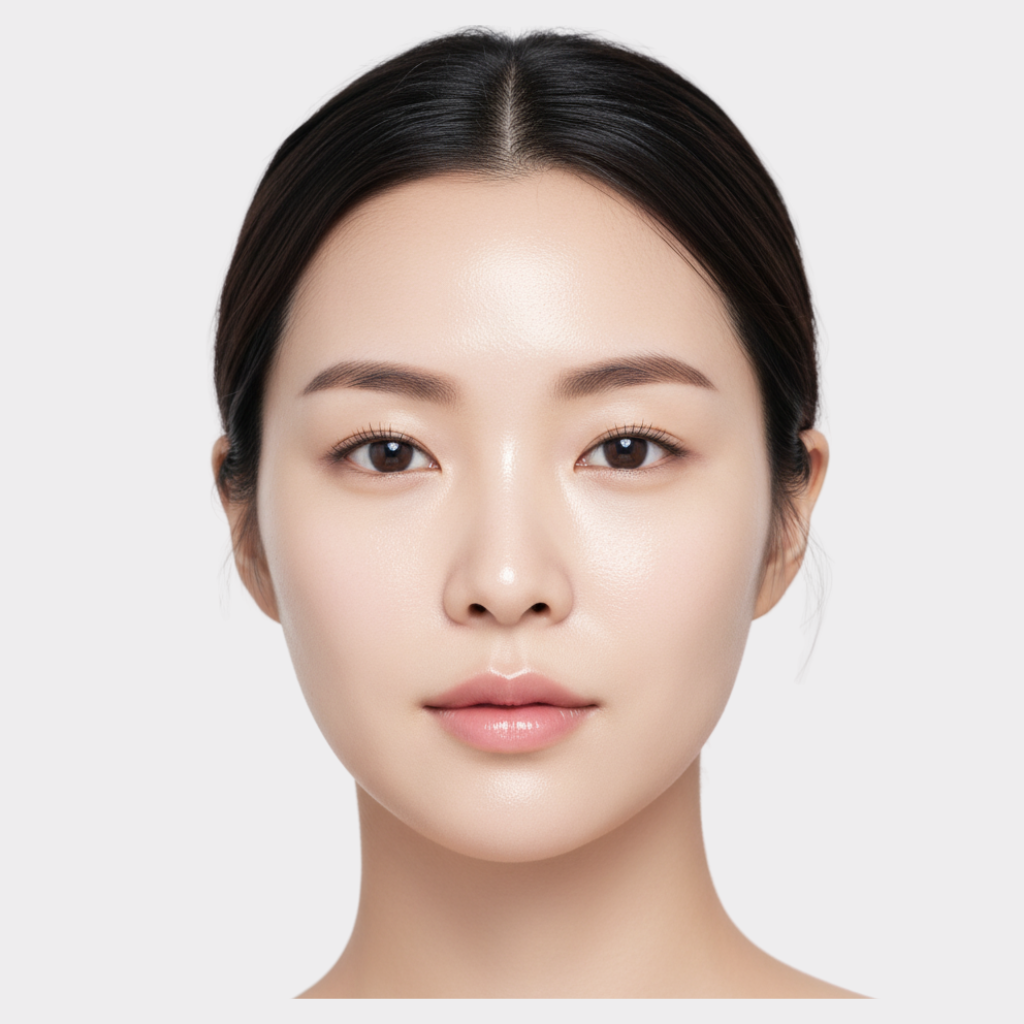
“Glass skin” (유리피부) is the Korean term for skin so smooth and evenly hydrated that it reflects light like a pane of glass. It is not about being shiny, and it is not a filter. It is about three things happening at once.
The three pillars
- Deep, layered hydration. Not one heavy cream, but multiple thin layers of humectants that hold water at different depths. This is where the Korean approach genuinely differs from the Western one.
- A smooth, even surface. Light scatters off rough skin and reflects off smooth skin. Gentle, consistent exfoliation and a healthy barrier do more for glow than any highlighter.
- An intact skin barrier. This is the part people skip. Over-exfoliated, stripped skin cannot hold water, and skin that cannot hold water will never look like glass — no matter what you put on top of it.
Why it is a process, not an appointment
Here is the thing nobody selling you a single treatment wants to say: glass skin is a maintenance result.
One facial will leave you plump, calm, and genuinely glowing — often for a week or two. That is real, and it is a lovely thing to have before an event. But the clients whose skin actually looks like glass in ordinary daylight are the ones who come in regularly and keep a simple, consistent routine at home in between.
If someone promises you permanent glass skin from one visit, that is a sales pitch.
Our Korean Glass Skin facial is built around those three pillars — layered hydration, gentle resurfacing, and barrier repair — rather than around one dramatic step.
3. Exosomes — the “messenger” ingredient in modern K-beauty formulas
What they are
Exosomes are extracellular vesicles — tiny packages that cells release to communicate with other cells. Think of them as messengers carrying instructions: proteins, lipids, and signaling molecules that tell a receiving cell what to do.
The interest in skincare is easy to understand. Most cosmetic ingredients work by supplying something the skin can use — water, lipids, antioxidants, amino acids. Exosome-containing formulas are designed around a different idea: delivering signaling material rather than raw material.
How they show up in professional skincare
In an esthetic setting, exosomes appear as an ingredient in topical serums and ampoules — the same category as a peptide complex or a growth-factor serum. Formulators add them to products, and estheticians apply them to the skin as part of a facial protocol.
That is how we use them at Aoki. Exosomes are one of the ingredients in some of the professional-grade Korean formulas we work with, alongside PDRN, peptides, hyaluronic acid, and niacinamide. They are part of a product, not a procedure.
Our estheticians will tell you exactly which products are being used on your skin during your appointment, and why. If you would rather we leave a particular ingredient out, just say so — that is a completely normal request and we accommodate it.
Setting expectations honestly
Exosome skincare is a newer category than PDRN or hyaluronic acid, and the published research is still developing. Much of the laboratory work is promising; the body of controlled clinical data on topical cosmetic formulations is smaller than it is for ingredients that researchers have studied for decades.
What that means practically: we include these formulas because our clients respond well to them and because the Korean labs we source from produce excellent products. We are not going to tell you exosomes will do something no ingredient has been proven to do.
If any provider — us included — promises you a dramatic, permanent transformation from a single ingredient, treat that as a sales pitch rather than information.
What we actually offer, and why
Our estheticians are licensed by the Texas Department of Licensing and Regulation and work within esthetic scope of practice. That shapes our menu, and we think that is a feature rather than a limitation.
Our K-beauty facials are built on professional-grade Korean formulas and careful technique — layered hydration, gentle resurfacing, barrier repair, massage, and consistency. The ingredients we work with include PDRN, exosomes, peptides, hyaluronic acid, and niacinamide, chosen for the skin in front of us rather than by script.
Every treatment begins with a skin analysis, because the right approach for dehydrated skin is not the right approach for congested or reactive skin, and a menu item cannot know the difference. A person can.

Frequently asked questions
Is PDRN safe for sensitive skin?
Topical PDRN is generally well tolerated, and its anti-inflammatory profile means it is often chosen for reactive skin. As with any new ingredient, tell your esthetician about allergies — particularly a fish allergy, given the source — and patch testing is always reasonable.
How often should I come in for glass skin results?
Most clients see the best results on a four-to-six week cycle, which roughly matches skin’s natural turnover. Your esthetician will suggest a realistic interval after your analysis rather than a fixed package.
Can I get glass skin results at home?
Partly, and the home routine matters more than most people think. Layered hydration, gentle exfoliation, and daily SPF do a great deal on their own. Professional treatments accelerate and maintain the result — they do not replace the daily habit.
Do you use exosomes?
Yes — as an ingredient. Several of the professional Korean formulas we use in our facials contain exosomes, applied topically as part of the treatment protocol. Your esthetician will walk you through the products being used on your skin, and you are always welcome to ask us to leave something out.
Is a Korean facial different from a regular facial?
Meaningfully, yes. The Korean approach emphasizes hydration layering, barrier health, and gentle consistency over aggressive single-session intensity. The philosophy is closer to long-term skin conditioning than to a one-time correction.
Come see us
Aoki Head Spa & Skin has three locations across DFW — serving Frisco, McKinney, Plano, and Southlake — and every treatment starts with a conversation about your skin rather than a script.
If you are not sure which service fits, book a free consultation. A licensed esthetician will look at your skin and tell you honestly what will and will not help.
Frisco & McKinney · (469) 406-1135
Plano · (469) 409-6076
Southlake · (469) 409-1715
A note on this article. This content is for general education and is not medical advice, diagnosis, or treatment. Aoki Head Spa & Skin is a licensed esthetics practice; our services are cosmetic and non-medical, and are performed within the scope of practice defined by the Texas Department of Licensing and Regulation. We do not perform injections, medical-depth microneedling, or any procedure requiring physician delegation. Statements about ingredients describe general research findings and are not claims that any product or service treats, cures, or prevents any condition. Individual results vary. Please consult a physician or dermatologist for medical skin concerns.
Last reviewed: September 2026